 Posted by
 The idea of talent management becoming an integral part of learning, with such a high level of intertwinement, made me shudder.
I am okay with the fact that talent/performance management, as well as learning, should be separate.
TM systems needed learning simply because without it, the substance of workforce development was limited. Additionally, it was and remains a cash cow.
I was never a fan of performance management.
The fact that some vendors publicly referred to themselves as an LMS, but privately referred to themselves as a performance management system, added to a bizarre obfuscation of intent.
Talent development systems have started to change the entire narrative of employee development and growth, incorporating learning not as a subset, but as an integral part of the journey.
Looking at 2025, a trend that I first observed in 2024, which was still relevant in context, pointed to a vision that I had to explore further.
Was what I was seeing coming to fruition in terms of employee learning?
Where vendors are really getting it, or getting lucky, winging it, or seeing themselves as some HCM, with this whole skills-as-a-learning-journey approach as essentials?
What is clear is that the bigger picture of where the employee training market is heading wasn’t apparent to everyone.
Yet, there I was, looking at the trends, identifying with lights of RED going “HERE, HERE”, that I began a journey, not of self-discovery, rather discovery that the market will march this way, perhaps not with all the components I will be presenting, but if a vendor wanted to get to the forefront of the next evolution of employee learning, all the capabilties must exist.
Whether that happens across the board in 2026 – I see this as a continuation, with some vendors pushing into it further in 2026, and other items in 2027 (especially around AI and following tiers of pathways).
To date, I have not found a system that meets all the marks in the Future of Learning for employees.
This will be reflected in my forecast in talent development systems, an LMS specifically targeting L&D and HR, as well as in learning platforms.
For employee training – and only employee training (regardless of level) the term I will use, and is presented as the core – the central hub of the learning system, will be the
Career Journey.
View and Download – The Future of Employee Training (Reading Time 10 minutes)
The 25,000 view

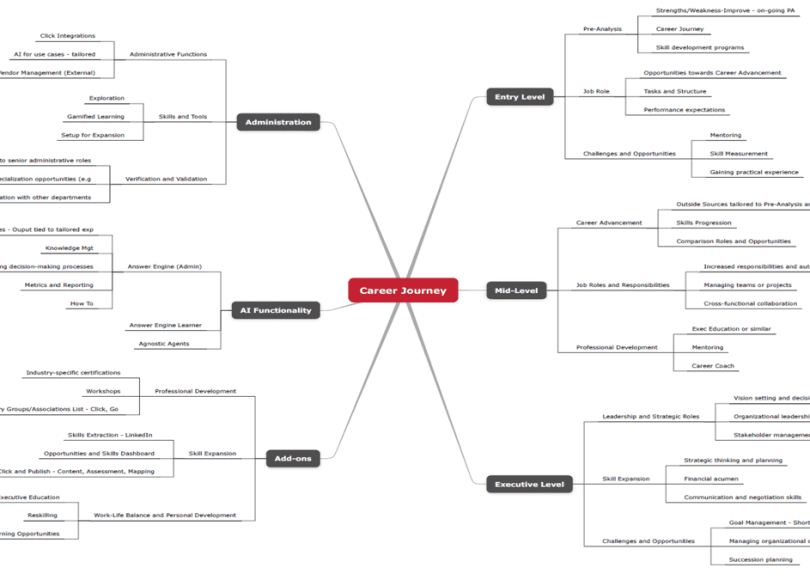
The Career Journey is the centerpiece for employee training/learning – it requires the use of a learning system, since the whole approach is based within the context of a Career Journey.
The Career Journey
It is made up of three essentials – Talent Development + Learning/Training + AI
AI
The Journey taps into two types of AI: Gen AI and Agentic AI (which is just starting, but far exceeds what Gen AI can do).
Over time, as more AI models appear than modifications to the center of the journey, if you will, inevitably change.
Do you need AI as the center? No, but you will definitely need it across the system in some manner – not just one place, but multiple places.
This part—the AI part — is a component of the Career Journey, which is why it is noted as such.
The Career Journey is made up of several parts – all, in my opinion, core.
The two core items Talent Dev and Learning/Training, appear hand in hand with the levels, and yes, add-ons.
a. Administration – Think of it as the brain of the entire system. Without it, your platform is really an FTP (File Transfer Protocol) or a file folder.
b. Entry Level – This consists of new employees entering the workforce and your company, organization, firm, etc, anything corporate-wise, including associations. It includes onboarding – but goes further than that.
c. Mid-Level – Often ignored in systems beyond the “manager” view. The journey incorporates this group – the goal, after all, for entry is to reach mid-level – and the investment in your place of business for these folks is an ROI, an ideal set for mid-level. Career progression is what we all want. Exception – Cookie Monster.
d. Exec-Level – Another big ignore in any learning system. While L&D loves the idea of leadership development, it isn’t universally applicable to everyone – it’s reserved for a select few. Why?
Exec-Level opens up the journey, as it may come as a shock to some people who want to advance up the food chain, as they say, to become an executive.
I will note that AI will definitely impact these levels, with entry being hit the hardest, and mid-level white-collar a close second.
Nevertheless, the career journey, while acknowledging this, offers attributes that can offset.
e. AI Functionality – As we know today. Six months from now? AI continuously evolves. There are real issues with AI, beyond hallucinations—a monster (not a cookie) in the room. Even with Agentic AI, it will not disappear. Ditto on Agnostic. AI bias is in play here, too – but that is for another day
f. Add-ons – I place this as optional for a system to incorporate, but IMO, there are great opportunities for a system to go beyond.
Continuous learning is the crux of any system, regardless of type. Yet, in the industry today, the words are just words; the real application doesn’t exist.
The Future of Learning changes that.
Breakouts
I will start from the right side – the levels

Pre-Analysis
A significant step for entry- and mid-level employees.
Anyone who uses the system for the first time goes through a pre-analysis.
No more, “Well, I think I’m a blah blah.” No more guesswork.
The system, based on analysis of employee responses, devises an entry-level plan using the various components of the entry-level experience.
It isn’t a one-off.
Any L&D or Training professional knows that to ascertain retention over time, truly, follow-up is necessary, ideally every six, nine, or 12 months with each employee.
Otherwise, it is total guesswork. The data isn’t really accurate – it is open for discussion.
Data drives learning – as I always note.
A pre-analysis initiates the process, followed by a follow-up analysis as the journey progresses, and it is modified as needed.
It is used at the entry and mid-levels only.
It is important to remember that while you can look at each of these levels and say, “Our system already does this,” – in actuality is lacks in so many ways. Especially as we go mid and exec level.
Therefore you will see in some areas I say “Self-Explanatory” then will add some context.
Entry-Level

Entry-Level
- Strengths and Weaknesses – A successful journey only works if it is truly tailored to the learner, and in this case, referencing the entry (plus mid). We too often adopt a “everything in one container” mode of learning, ignoring differences in learning styles, approaches, and individual characteristics. The idea of personalization is a debatable concept – adaptive or not – but if it is truly adaptive, then everything must be, which we all know isn’t accurate.
- Career Journey – Yes, it is repetitive – you see it as the hub, but everyone starts right at the beginning if they are out of school; that’s our entry point, regardless of whether you are deskless, blue-collar, or white-collar. The entire journey is for everyone, not just one group.
- Skill Development Programs – This is what systems exist with today, different types of skills and functionalities. It doesn’t go away; instead, the pre-analysis picks the right pieces specifically for that individual. From there, the development takes off. The “you need to know every type of skill, related solely to your job role, ” isn’t accurate. The skill is now; it can change a week from now. A new skill could come up, or the skill identified by a manager could be erroneous and not relevant for the employee. Again, the one-size-fits-all approach doesn’t work. Sounds excellent, real world? No way.
Job Role
Pre-Analysis better defines the role, beyond what the person has been hired for and what they are expected to do.
You can’t have career advancement based solely on the job role and current defined skills. People often overlook something called empathy, which is highly relevant.
Let’s not forget that the “opportunities” many systems offer often overlook personality fit.
You can have it all, but if the manager or whoever you are interviewing doesn’t see a fit, you are not going to get that gig.
It happens today, right now, at your company.
So, the idea that “ignorance is bliss” using a system shouldn’t be accepted.
Tasks, Structure, and performance expectations are again self-explanatory.
The latter must be presented clearly, with no ambiguity, and within a system that is very doable.
Add digital signatures as part of it, tap into the results via the system, and leverage learning as essential, and you’re off.
Tasks – this is where Agentic AI can truly excel, thanks to its design.
That said, tasks in this journey are the tasks that the manager, or again, whoever notes, are requirements of the role, as well as ongoing tasks.
Why systems have folks download PDFs or do things offline from a task standpoint without any verification that they completed it themselves, and not using Gen AI, is beyond me.
Deep thinking is not a reality with Gen AI, and as a result, a cut-and-paste job, or allowing an autonomous agent to handle tasks piece by piece, is happening in your workplace right now.
That’s fine – but for learning?
Challenges and Opportunities
I have noted that there are overwhelmingly systems that are geared for white-collar professional workers and deskless, but not deskless from the standpoint of blue-collar.
Yes, some systems are only deskless and blue-collar focused; however, when you bring in all three – the opportunities part, the skills part, the career advancement parts all are geared towards white-collar professionals in the office (remote too).
I have yet to see all three, where someone starting on the plant floor has opportunities for career advancement and skills development, as well as equal opportunities to progress beyond the foreperson role in the plant.
Everyone has dreams, aspirations, and knowledge.
Systems – and I blame this more on the companies, not the vendors, who ignore this, even though there are plenty of stories about CEOs who started out working on the floor at a manufacturing plant.
Mentoring is crucial for new entrants.
Too many people view mentoring as being only for management or mid-level professionals, rather than at the beginning of someone’s learning and career journey.
A mentor can open up new possibilities and ideas, beyond what a coach will do (focuses specifically on one or two items related to a role or skill to learn).
Real-world practice scenarios should be included for entry-level professionals.
Colleges and Universities are often criticized for not adequately preparing students for the real world and real-life experiences; therefore, a learning system must fill that role.
Text alone or clicking as though it is a hot spot in a course isn’t the real world.
Real-World taps into that experience, utilizing what the learner already knows and will need to know, and builds upon it.
Pre-analysis starts it off, then ongoing learning drives it and develops it, and each scenario – yes, it isn’t just one – goes deeper than before, ranging from easy to advanced.
We all want to be challenged in different scenarios, depending on previous ones, where we can always go back and learn more. However, challenges also motivate people to learn more, allowing them to learn and adapt.
Skill Measurement
The first step is the pre-analysis.
I never understand why companies seem to be okay with an employee (learner) claiming to be an expert or mid-level in a specific skill set or skill without proper validation. I can say I am an expert in Excel.
Then you say, ‘Okay, what can you tell me about Macros?’
They say, “Huh?” – You think, okay, not an expert.
Skills develop over time, and measurement must do the same.
Clear explanations of each skill you want them to attain or that they say they have must be visible.
Open up the possibilities.
Skill ratings are, in most cases, an utter joke.
Rate yourself on a scale of one to five, without us telling you what each rating means, and without us knowing beyond perhaps an assessment after you are assigned a course.
Hey, did you know people can guess and memorize?
And that the person reviewing the rating may be basing it on subconscious bias or current bias on what they themselves know or don’t know?
What’s more relevant here – skill measurement that is accurate or skill measurement that is like the amount you feed your dog, and you guess that the one you think you see is actually a one?
Admit that we all guess on some of the unclear cup numbers.
Mid-Level

Who is overseeing your system? What department? Do they have the background and experience?
I bring this up because going through the career journey makes assumptions that the person or people overseeing the system are aware of and knowledgeable about all this information, have a relevant background in it, and can identify and quickly make adjustments.
Yet, more than ever, people overseeing a learning system lack L&D expertise, including those with OD backgrounds.
They lack any training in learning or even training modalities. They couldn’t tell you what ADDIE is/was, and they don’t care.
I meet L&D executives who are unaware of key metrics, the relevance of interests to skills, the importance of learning styles, and why they exist – even though they themselves have one, and zero knowledge of effective course building.
Nowadays, people overseeing a learning system want the system to do everything for them.
To handle their learning and development, and training.
Recognizing this is key in understanding the role of a Career Journey in the Future of Learning.
Mid-Level Specifics
I’m going to jump here a bit and focus on a couple of items.
Again, you can say, “Well, my system does this,” and if they do, congratulations – but I guarantee you that without a pre-analysis and ongoing monitoring, it doesn’t.
Additionally, onboarding is heavily geared toward new employees entering the company, especially with a learning system.
Mid or Exec level? Doubtful.
The capabilities of a dashboard for mid-level career advancement are lacking, including the necessary content, required actions, opportunities, measurements, and analysis.
Content sure. Progress bar – yes. Skills, probably yes. Okay, then what?
Ignore assigned learning because it is geared towards skills, never specific to the mid-level employee, and definitely not a mid-level employee who is deskless.
The measurements fail to convey the learner’s career journey story. It lacks their input – yep, it should present an opportunity for that person to say it.
It lacks identifying them as their career coach and mentor(s).
They go here and there, to see what is needed, but a dashboard is designed to be a high-level overview of key takeaways.
Executive Education is heavily geared towards mid-level folks. But where do they find these programs? Oh, search the internet, which is full of junk, also known as content marketing.
Why not have the learning system vendor list the executive education programs that are available, based upon some pre-arrangement with the university/college that offers the program?
The program exists within the system; it has to be entirely online.
Sign up in the learning system, and bam, you are in.
The cost?
Your company deposits credits into a virtual wallet that employees (mid-level and above) can access to purchase into the program.
Trust me, a certificate of an executive education program from Harvard goes much further than a certificate from LinkedIn.
I rarely see someone state that it is an executive education program on their profile.
One of the great advantages of executive education programs is that they are available worldwide.
You are not limited to one place.
The learning system vendor does the legwork – you, as the client, see the benefits for your employees, including retention, development, and growth. The employee, however, is unaware of the benefits they can attain through you via the learning system.
You want usage? You will get it.
It’s a great career-building block that shows real-world value.
On the career coach side, what if you, the learning system vendor, or the client themselves offer coaches that have specific experience from an external standpoint? If Zig Ziglar (the G-D of Sales) were still around and offered to be a sales coach, I can guarantee you that anyone at mid or even senior levels would want them to be their coach.
Again, credits are deposited into a virtual wallet, or there is a partnership (i.e., a revenue split) between the vendor, the coach, and possibly the client.
The opportunities for a coach and exec education and mentoring are endless – but it requires some initial legwork, and a virtual wallet and people who understand that they have to handle it all, no longer assuming someone is going to go the extra mile to find these offerings on the web, let alone know about them.
Deep-thinking exercises within the system for mid-level job roles and responsibilities are huge.
Take some real-world scenarios, require folks to think about this and that, and then see an output.
Want to leverage a mind-map with a system? Why not have it in there? A system could offer some very amazing integration capabilities if it so chooses to.
I recall one vendor who has/had a partnership with Canva. You can go into Canva, and it outputs within the system itself.
I am still baffled as to why nobody else has done something similar with all the SaaS offerings out there.
If I want my mid-level folks to learn how to write an effective proposal, what is better:
a. Take a course that is text-based, non-interactive, and then an assessment
b. Course with a real-life scenario which requires the employee to create the proposal within the system
c. B plus the usage of say Canva to add some sparkle
d. B plus C with AI autonomous agent
D would be ideal, but heck, B would suffice for now. C an added plus.
What do you tend to see? A.
Exec Level

Anyone who has run a training or L&D program with an LMS, Learning Platform, or some other type of learning offers it to everyone.
The C-suite personnel, depending on the company’s size, will either request to be signed up or you will sign them up (as a courtesy). Ditto on the President level.
They never use it.
And yes, that may be the case when it comes to using an exec level within your system, with all those offerings.
Execs still use Career Coaches – granted, it isn’t somebody you find at the bus stop (unless it is a bigwig who likes taking the bus home). They want the big-time folks.
If Mark Cuban offered to be a mentor for your system on X, Y, or Z, I guarantee some senior exec would jump at that chance.
If it were Mark Durbin Widget, probably not, unless the DW is a billionaire who is the master of strategic planning; then, yeah, they would get folks.
All the items listed in the Exec level are items they will need to know.
Yes, I left out empathy, which, in a post that I interviewed learning system vendors, many noted was a crucial skill. Still, you, the learning system vendor, could have courses/content around empathy, including workshops, seminars, and even in-depth scenarios that the exec would work on within the system.
You see me mentioning working within the system, rather than offline or out of the system.
You want to tap into the knowledge they are presenting and enable real-time responses from the system, thereby driving growth and expansion.
Thinking is a crucial skill, and as we incorporate more AI, we will inevitably miss out on it to some extent.
Let the AI do it will become the mantra.
However, thinking and learning go hand in hand. You need both, ditto on training.
If a senior executive offered to be a mentor to some mid-level folks around strategy, there would be takers. However, having the mentee download a document to read offline or peruse a video online within the system provides zero proactive engagement.
You don’t know what you don’t know – and for a system, and thus for the client to see, it has to become a part of the system.
A strategic plan could be a series of templates – first steps for some execs – new to their role, or more advanced for others.
It can also involve scenarios established by individuals or groups with expertise in successful strategic planning for AB or C.
On the left side of the Learning System Career Journey, I will highlight a few areas and cite some notable examples that I have seen, or why they would be of great use to a vendor and, by extension, a client as well.

Administration – The Brains of your Learning System
Often underutilized by clients, underwhelming UI/UX, which doesn’t help, and difficulty in figuring out what is relevant and not relevant to those new to any learning system.
I am not going to dive a lot into AI here, because I’ve written about content creators, assessment, and skills with AI, which I present more under the AI piece – the same with an answer engine, which again over time will be utilized via an Agentic AI and not Gen AI (IMO).
I want to clarify for a better understanding, though.
Use cases tailored from AI, Vendor Management, Click Integrations, and Setup for Expansion (an example).
The scenario I present here for use cases tailored could, in time, be adapted to a learning system.
How often do we hear the following
“What is your use case? Our use case involves this, that, and 500 employees, and we lack this and that; we need this and that. Our system is perfect for it, because we can do this, this, this, this, and more. Perfect.”
Fantastic!
The problem is that unless you are looking at a system heavily focused on large enterprises and need a system geared towards 1,500, then the use case won’t succeed in the long term.
Heck, even short-term.
Remember, the system is designed for a specific type or a set of particular kinds of clients, sizes, and audience focus.
What would happen, though, if the vendor incorporates your use case into their AI, here using Agentic, and the system then extracts the necessary components for the use case to become an integral part of the system itself?
We are not there yet, in terms of a full-throttle experience, but it doesn’t mean it won’t eventually come or become available.
Not likely in the next year, but within two or three years, with high efficiency. Sure.
You could create a lower-level use case tied to your learners and specs targeted.
At some point, it will be feasible by the end of 2026, even a summary, which is more likely to be developed by a vendor or vendors by mid-2026, from which the summary can be derived.
Oh, I’m not referencing a multimodal answer engine.
Vendor Mgt
This has been tried before with vendors and failed. Some vendors still offer it as an add-on and are targeting very large enterprises.
There is, however, no reason for a company that provides external training to keep track of third-party vendors it uses for learning and training purposes, such as food suppliers, or to manage vendor tracking for these purposes.
Is it for everyone?
No.
However, you could switch this for, say, learning operations, which a couple of vendors specialize in – that is their business.
If you do not need everything they offer, a scaled-down LO makes sense. Again, the industry points to an increasing number of individuals overseeing learning systems, including those who lack the necessary knowledge but need to handle it.
The same applies to extensive scheduling beyond what 98% of the systems offer today.
Extensive scheduling isn’t just for Global 2000, but also for specific industries, such as aviation.
Rather than using a third-party service like Training Orchestra, you could integrate directly with it. Your system does this ahead of time, and now you can offer it.
There are other providers out there, some of which expand far more with external capabilities, such as room scheduling, allowing people to sign up for seminars at an event.
I’m always surprised by how many association-focused learning systems lack this option, even though the big money maker for an association is their trade show.
And what do they do at that trade show?
Learning!!
Click Integrations
The systems that offer it are by far ahead of the game when it comes to integrations.
I’m not referring to Zapier integration or some workflow approach; instead, you view a list of integrations the vendor offers, click on the one or ones you need, and then enter your username and password.
Auto connects.
You know who used to do an excellent job at this? Saba.
Many moons ago.
Vendors who do it today make it so difficult. You have to find the webhook (what is that – I know, but I am using this solely as a reference statement), or API key.
Who has time to find this stuff?
Today’s learning systems must be designed for speed and efficiency, and they must also understand their audience(s).
For the career journey system, speed, realization of heavy HR usage on the back-end, and even L&D folks who lack a specific understanding and information around all this must be adapted to it.
I recently discussed a learning system that, using a prompt, was able to display the specific responses to a report with the necessary metrics.
The person asking didn’t need to know how to generate this report, let alone look for it, or the metrics for that matter.
They only needed to know how to ask a question and have the system show it.
That is an excellent example of metrics and reporting with an answer engine, tapping into the brains of the system with AI.
The AI part has been covered so that I will pass on that. However, agnostic is really taking off. Thus, if a vendor claims to be AI-agnostic, it means that their system will work with various providers, such as Google Cloud, Microsoft Azure, Anthropic, and AWS, to name a few.
The best option is Bedrock from AWS, which offers a wide range of LLMs (Large Language Models) for various use cases, including Small language models that can be utilized accordingly.
Considering that the majority of the industry has its learning system on AWS.
If you are debating on what LLM to use and are not interested in Bedrock, Anthropic is, as of this writing, the best.
Depends on what model you choose, of course.
Under Add-Ons for Professional Development
- Industry-Specific Certifications – Many people are unaware of the certifications available for their industry. If you are focusing on construction, for example, there are industry certifications that exist. So why aren’t they listed in your system? Again, click and see what is required for that certification within the system (common, btw, for example – that content you are taking from a 3rd party? It’s not sitting on your LMS’s servers). You pay the fees (Virtual Wallet, paid by the company, not the vendor), and now you can work on that certification. Trust me, a certification from an industry-specific means far more for a future employer, even a current employer, more so than one saying you have a certificate from LinkedIn.
- The ISC list here requires the vendor to go beyond knowing the highlights of your industry; it involves finding out the specifics and, potentially, working with that specific certification provider.
- Industry Groups/Associations – many people working in various companies or businesses, in specific departments or job roles, are unaware that industry groups exist for them in those areas, and the same applies to associations. Did you know there is an association for party rental? Amusement Parks? Marijuana Providers, yep, there are. They all offer content, by the way, and certifications in most cases. A vendor could provide at least a list of these groups with a point of contact (Since most people are hesitant to sign up unless they know who they can ask questions to, or talk to). If you want to be a system that truly supports employees’ careers, why not take the extra step and demonstrate it by showing value? Here is an excellent example of a networking program in the same industry as the employee, and at the same level. The fact is that the days of meeting in person are giving way to virtual meetings. Communication still rules, though – face-to-face virtual is ideal. Again, you want people to see the real value in your system for their career—and the client wants that too.
Bottom Line
There you go.
My forecast suggests that this will become inevitable.
Pieces are there, pieces are not.
It won’t be simple to implement everything, but the forecast doesn’t require it to be all in place now.
Rather, it says – here is where the future of employee training is going
Talent Development + Learning/Training + AI =
A Career Journey
Learning System included.
E-Learning 24/7