 Posted by
 It’s that time of year when folks flock to trade shows like LTUK and ATD.
A quick perusal of exhibitors shows many with some form of AI.
AI video creators. AI transformation of content.
AI is everywhere in these shows—powering scenarios, skill development, and more.
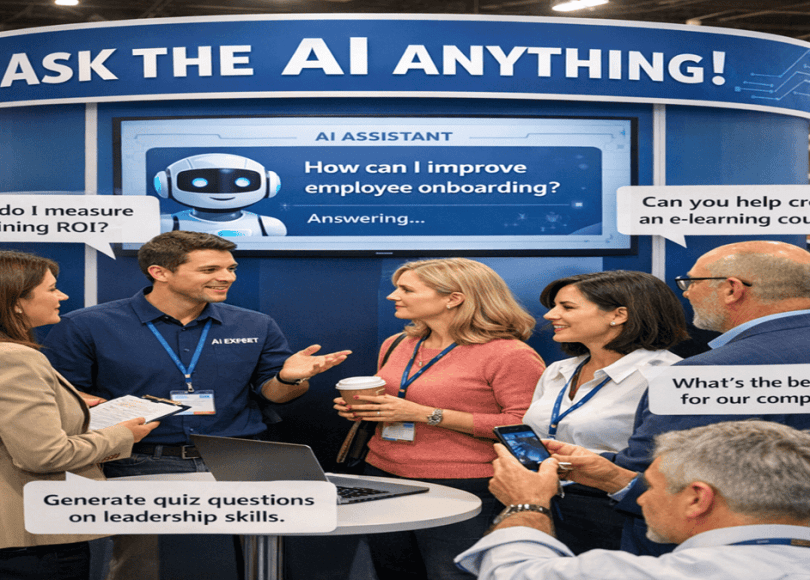
To help you cut through the noise and ask the right questions about AI at these events, here’s a focused guide (this post).
Terms to Ask
MCP (Model Context Protocol) is the latest; go ahead and ask whether they are using it.
Other MCP Stuff to Ask
- Can I have the platform/knowledge management (i.e., the vendor you are talking to)- be used in your LLM – your company’s one, if they are using one.
It works this way – you are currently using your own Learning Language Model – let’s say, Copilot or Claude.
The vendor’s platform using MCP can be integrated into the LLM, with some capabilities. I have yet to see a 100% system MCP integrated into your own LLM.
For example, a vendor-knowledge management system, Talvi (product review next week), can do this – MCP.
2. Does your system have an MCP store? This is the latest, and if you need it or seek something like it, it is a huge plus for a vendor to have it. There should be more than 10 MCP offerings
Vendors love to talk about guardrails, and they have a RAG.
The premise is simple: we have all this stuff, so the human loop element isn’t as crucial, since we are 99.99% accurate or fully accurate with your own content.
However, these claims are not entirely accurate.
If they are using an AWS solution, such as Bedrock, it would make sense to ask how they use it in your system.
If a vendor says they are using Claude, then I want to know how they handle the data throttle that Anthropic is doing with mass usage – yep, that’s right, just like those telecomms.
If your company values environmental protection, ask about data centers’ impact—energy use, costs, and water consumption.
I want to know whether the vendor is using or planning to use an SLM (the term varies, but it means a small language model that can run on a mobile device, even a laptop, and push out nearly as many parameters as the big LLMs).
Here are a few other items I would want to know
- Token fees are costs for using an AI system, as tokens are units of text processed. Low usage poses little concern, but high usage raises fees. For example, 10,000 users a day asking the AI Assistant questions increases fees, since each prompt is not free.
- Natural Language – I want to learn more about their approach and ongoing work in Natural Language Processing (which you want).
- Processing chips are specialized hardware needed for AI operations. A major shortage of these chips drives up vendor costs, since LLMs or SLMs—foundations for Generative AI (Gen AI)—must be used. NVIDIA, the leading supplier, faces this challenge. Even if a vendor builds its own LLM, significant computational power is still necessary. Vendors pass these higher costs to you. What strategy does the vendor have?
- Does the AI assistant’s prompt window offer suggestions? You want this, as suggestions spur new ideas or actions.
- Does the vendor display a warning: ‘AI can make mistakes. Always verify accuracy before accepting results.’ Some suggest human review before accepting.
- Does the system allow you to create your own AI agent (a vendor may call it Agentic)? The creation capability has to be easy to use. I’ve seen ones that are very complex.
Vendors often assume people know AI can make mistakes and compare it to human error.
I rely on AI, expecting 100% accuracy, but even small mistakes, like in PowerPoint, can hurt a company. AI bias can slip in unchecked.
There is data showing the potential impact on folks who use AI a lot and get attached to it, as if it can do everything for them.
I laugh at claims that ‘AI frees employees for other work.’
If AI handles tasks, why would employees take on others if they see AI doing them?
While AI cannot do deep thinking, it can handle many tasks in L&D, Training, Marketing, and Finance.
You need a spreadsheet with computations based on a series of data points, usually handled by macros?
Gen AI can handle those spreadsheet needs.
What I want to know
Ask vendors how their Gen AI platform enables you to measure and enhance the Impact of Learning, which is a more meaningful goal than traditional ROI.
I’m a huge believer in IOL over ROI, because I can tie the impact to the company’s business goals and objectives.
Use data instead of vague claims like ‘happy employees work more.’ Ignore unknown variables.
Show the impact on goals or profit centers; usually, better results lead to more budget. Online learning isn’t one-and-done.
Show your boss external training generated $250K—big impact, clear benefits.
Benefits include more budget, resources, and less oversight from HR/IT (if applicable).
Now, let’s consider your specific objectives:
- The vendor must provide ongoing AI literacy for all users. If sales lack AI knowledge, why buy? Vendors should update, not you. Stay informed and keep your team updated, as few read support guides. Some vendors shift responsibility to buyers.
- Ask questions. Don’t accept jargon; clarify if unsure.
- AI roleplaying can bore users. Roleplays should require deep thought and align with job roles. If in construction, I’d prefer a relatable roleplay scenario.
The fact of the matter is that people learn better when the stakeholder is like them.
Thus, the coach isn’t a manager – rather, it is a person who works in, say, construction and achieved XAB, which is why they are a coach for that employee.
Transparency
I am a huge fan of Bedrock and the other AWS AI offerings.
So much so that, for my FindAnLMS platform, I will be using an AWS AI product (launch in Q4, 2026).
Bottom Line
DigitalChalk is on track to become the first LMS with a complete learning intelligence infrastructure built 100% on AI.
What I have seen is really getting me thrilled about what is possible and what is on the map with DigitalChalk.
There are other vendors that use Bedrock, such as SparkLearn, designed for frontline workers, and Cornerstone, which works with AWS on a variety of AI offerings.
If you want to see who I have in my top tAI learning systems (as of May 2026) (rankings and insight to be published), Thrive Learning is definitely impressing me. DigitalChalk, Absorb, Cornerstone, and Talvi are equally worth a check.
Learn Amp is another one, too.
They are ideal for L&D, IMO, and their AI-based learning is strong.
At the end of all those AI learning tech offerings, ask yourself two questions:
Ask: How does this solution help validate the company’s meaningful learning impact?
Ask: Will using this AI system drive repeat engagement and support ongoing learning for your users?
Remember: The true goal is to entice learners—your end users—to return to the system because the AI makes it valuable to them.
Not you.
E-Learning 24/7