 Posted by
 This is the time of the year when the deadlines are getting tighter, and people are wondering if they will have to try that new dish from Tommy, a recent hire who told you secretly that he worked at a place that was shut down due to health concerns. Oh, and he was the cook.
Writing two posts about awards, while exciting, is equally daunting. No analyst goes into this thinking Hey, I can write this up in an hour and then head over to the pharmacy because Tommy happens to be your boss and he is making his famous hot dog soufflé.
The best in class awards are broken down into two areas – this week, it’s all AI.
Next week – Best in Class covering the aspect of strategic outcomes for the business – with frontline, enterprise, mid-market, mentoring ,etc.
AI Factoids
We often say that AI is still in its infancy, but it’s important to note that the current capabilities are just the beginning, with significant growth expected within a year or two.
One AI vendor whose valuation is over 1 trillion dollars may not be around a year from now, because it is a capital-heavy investment with so far a lack of return.
The AI market is in a bubble (and as I’ve written before, there is no doubt it will go the dot.com route, sadly). Recognizing this volatility can help you stay cautious and make more informed decisions.
When a vendor in our space, including learning systems, adds AI, they should carefully consider how it aligns with their core mission and expertise – (Impact of Learning), in this case, strategic outcomes for the business (regardless of vertical).
Add it – just for the sake of it, and place it where clients want it (BAD idea, but common) or add it, be diligent about where it should go based upon the vendor’s expertise (not common, but the smart move).
The Categories under AI for Best in Class are
- Top 5 AI-focused learning systems
- AI Content Creator
- Analytics and Metrics – 100%: There are some folks out there who do it way better than others and show what is possible at this stage in the space.
- Admin Functionality – These vendors are leveraging an AI assistant on the admin side – very early here – but still stand out
- #1 AI-Powered Learning System (yes, one stands above the rest – and includes it all – uh, AI capabilities when you buy the system)
- AI Assistant – Learner Side – This is gaining popularity, but some are the early leaders, and two I see do the best job, sadly, only one can be Best in Class (or can it be two?)
Regarding AI, please note that you should always ask what LLM (Language Model) or models they are using, and whether they charge token fees. As of 12-10-25, the number one LLM is Gemini 3 (Pro).
If a vendor says they use Bedrock (that is great – because Bedrock identifies the best LLM or the one it feels aligns well with your use case – Bedrock is from Amazon, which is AWS in this regard).
Now, without further ado
These systems leverage AI across many areas – I found them overall to be top of the class for AI.
- Cornerstone Learn. I am referencing Learn here – which is excellent, and to the ideal Talent Development system – you should add Elevate.
- AI Admin Functionality – Includes an AI Assistant where the admin can create a report, receive product help, navigate the system, manage compliance, use the content manager, access suggested training, and search training.
- Automated content creation, with a different look than the common ones I see
- Streamline learning operations
- Learner functionality – Personalized learning and recommendations
- Managers – AI summarized reviews and check-ins
- Skills development tied to content (which is in Elevate+, but there are some items in Learn+)
- Admin – Metrics such as instant learning insights
Some Screens
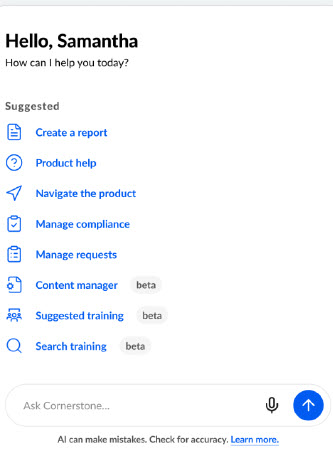
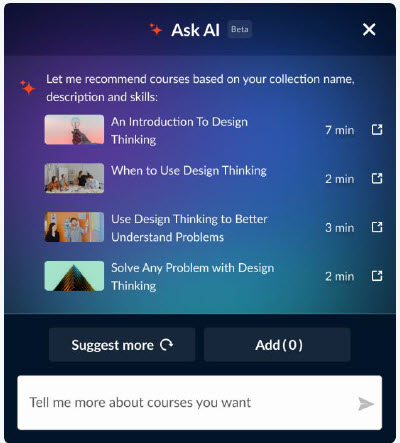
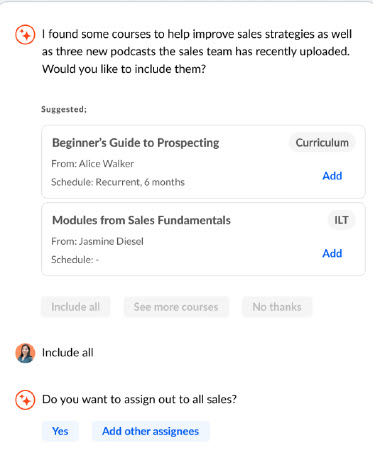
Everywhere you can with their AI – they always note that it can create mistakes and check for accuracy.
Based on all the systems I have seen with AI, the most significant universal problem is the lack of that little statement.
2. Absorb LMS – There is a reason that they have pushed the envelope with AI. They get “it”. I was blown away with features such as Create a Podcast (yep) with AI – an intriguing angle in the space (oh it is just for within the system, and not for public podcast sites) – but it taps into people’s learning styles; Aura Assist which speeds up the admin processes, beyond the content (a usual piece), but items such as strategic learning playbooks and running reports.
Together – their mentoring platform, which comes with Absorb LMS (you can also buy it as a standalone) – uses AI in a variety of ways: matching profiles based on skills and factoring in time zones. These AI-populated agendas evolve with each session, making it easier for mentors to sustain engagement with their mentorees.
3. LearnAmp – AI tutor, a slick AI Assistant (different than a tutor) – known as Volt, a multi-agentic framework with different agents handling various tasks, a content creator, to name a few.
One big ticket item you want when you purchase a system utilizing AI is MCP (Multi-Cloud Platform), they are in the process of having it – that is a significant win. RAG (Retrival Augmented Generated) – is quite common, LearnAmp has it, but they are working on adding MTP (Multi-Tenant-Platform), which is new in the market – again, you want this.
4. Cypher Learning – Really has taken it up a notch. Always been strong on the content creator side, but the Assistant’s UI/UX really works for me. Other items include AI cross-check, AI image generation, and administrative guardrails, allowing platform administrators to set open-text instructions to control the types of questions the AI will answer (e.g., blocking specific topics). CL also notes the potential of AI mistakes.
5. Docebo Harmony – Two takeaways here. 1. 2026 Q1 is going to have a very cool feature that I have yet to see with AI and your browser. 2. The search, discovery capability with AI in their system today – on the learner side, really worked for me. I really liked the option to search the platform or the web. Vendors nowadays place heavy restrictions on content within the platform.
The problem is that it limits the learner’s opportunities to learn. Clients assume that a content platform will only eliminate hallucinations (not true), AI bias (not actual), and output more effective results (depends on the content, and even then, the top two above are in play).

Pifini Learn (formally known as NetExam)
Without a doubt, the best use of AI with analytics. The system is 100% focused on customer training/education, product enablement, and B2B, and thus, the data output shows it off.
They debuted with a support analysis, which, from a customer/client standpoint, means that the client is using the system for product tech, for example, or for call-ins on issues.
Support eats into the cost of running a business, and can really impact whether the costs can be reduced for those calls.
The other one, though, I felt more comfortable when it comes to customer training and insights.
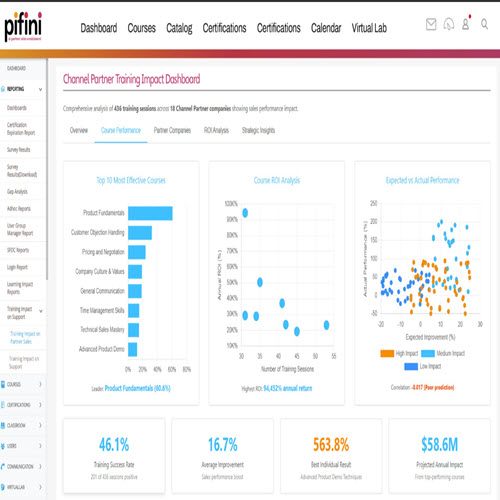
This is data you can utilize in numerous ways to boost sales (a key objective for customer training/education, B2B, and even with associations).
Cornerstone Learn
This is the AI Assistant on the Learner side. The goal should always be about helping the learner, not as a co-worker, which doesn’t benefit the learner – you want the learner to learn, and there are ways to do it with the assistant.
I identified the options you can see when talking about #1 with the AI-Powered platform.

As noted in my LinkedIn post – “I loved the ability to track elements within the content – let’s say a video you have, or a PPT, which then generates insights that validate learning impact to business outcomes.” Other wins include:
- Converts PowerPoint decks or long-form videos (e.g., YouTube URLs) into new units or modules.
- Extracts information, including speaker notes, and organizes it into editable pages.
- Allows selection of templates for consistent branding and look.
- Incorporates intentional friction points that require human review and editing before content is made available to learners.
- Can generate knowledge check questions based on page content.
- H5P interactives offer better tracking and metrics (e.g., scores) than basic elements. I recommended they drop the H5P term, because it isn’t relevant; what is relevant is the data tracking and stronger metrics.
- Allows remixing content by increasing or decreasing text complexity and adding custom instructions.
- Complexity refers to the use of more precise technical terms, complex sentence structures, and enhanced vocabulary.
- Suggested improvements include using more transparent labels, such as “Beginner, Intermediate, Advanced,” for complexity, and offering specific tone options.
- It can modify content for different target audiences (e.g., junior vs. experienced members).
- It offers suggestions for summarizing paragraphs, spacing, and incorporating additional assets.
The big downer?
Only some of these items are included in D2L Core (the base LMS). Other items are an additional cost, which I believe is a massive mistake given their remarkable capabilities.
Bottom Line
With AI expanding, these systems/platforms above are leaders. They may not have everything you want, and yes, others are doing this or that that you do want.
The notion that RAG, extended guardrails, and fine-tuning make the platform 100% accurate is 100% not true.
In fact, researchers have found that a lot of fine-tuning actually has a negative impact, outputting garbage, which impacts your learning and training.
I suspect the salesperson who pitched you on AI probably failed to mention that when they talked about extensive fine-tuning.
Agentic AI is early. Automation is what all the systems I have seen utilize, or at least tap into.
Fast. Fast. Fast.
Augmentation is what you want first and foremost for your learners.
And for you,
The understanding that AI is very early.
And ignore the hype around the latest version of an LLM, like OpenAI, and focus instead on the terms MTP and MCP.
They are technical, but if someone is pitching higher accuracy, ask them about MTP.
Finally, the most repetitive statement I hear about AI is that it will improve and advance NLP (Natural Language Processing).
The systems above are learning and training driven, with AI as a complementary tool – as it should be.
Not a gimmick.
Not a way to sell you their system.
A tool to drive your learning and training
E-Learning 24/7
The PDF version of this post, with additional screenshots, will be available on Dec. 21st. I will provide a link to find it.
One thing to keep in mind with the AI LLM’s is that when those engines are deployed in a privately hosted environment, with access to train only on the learning library of the user, they can be engineered with rules and constraints to avoid the dangers you are alluding to on the publicly available LLM’s which are programmed to please, and so will make up an answer if they don’t have one. Our experience using Licensed LLM’s from several vendors has been that with the proper configuration and rules in place the answers are 100% in sync with the content they are trained on. A downside is that if there is not a good answer available you just get whatever error message the programmers set up, such as “Sorry, I dont have that information” etc. It still is a case of garbage in, garbage out, but you have control of your own garbage. That is the value proposition.
All LLMs whether in a privately hosted environment or not, will create hallucinations. Research even shows that the more fine tuning the higher the probability of garbage coming out. We are not yet at the World model, and even then it is not perfect. The goal is to get away from predictive LLMs, but there is no sign that AGI will come into play in 2026, and unsure about 2027. Singularity is the ideal way, but even the best estimates are 2030.
The world model thus will be the best approach for learning to be quite honest, because of the way it works.